Learning Blog
Home | Blog
Since physical abilities decline as people age, many people think the elderly are also less able to perform mental gymnastics as they age. New research indicates this might not be true with all brain-powered tasks: In some ways the elderly are fit to compete with their younger counterparts.
Both young and old brains take longer to reach decisions in some settings, the researchers say, because they make the conscious choice to choose accuracy over speed.
Researchers from Ohio State University studied how people of different ages performed when put through a battery of cognitive tests, which included guessing the number of asterisks on a screen (fewer or more than 50) and identifying strings of letters as either words or non-words.
The new research added young children into the mix, from primary to secondary school age. They found the very young children slower at decision-making tasks, with performance improving with older groups. Younger children are not able to make as good of use of the information they are presented, so they are less accurate. That improves as they mature.
Individuals aged 60 and older also had a slower response time for these tasks, but the researchers found that instead of just taking longer to follow the same thought process as young people, the older people took longer to make sure they responded accurately. These older people even could be trained to respond quicker in some decision-making tasks without hurting their accuracy, similarly to younger adults.
Some memory tasks do decline with age, though. Some studies that show older people are not impaired in accuracy, but other studies that show that older people do suffer when it comes to speed. Previous research has shown that a mental facility called ?associative memory? ? remembering two connected memories together ? declines as people age. There?s still hope for other types of brain tasks, though. Perhaps not all brainpower declines at the same rate in the aging brain.
These findings were published in the January issue of the Child Development journal.
Source
1 February 2014
Great apes weigh their chances of success, based on what they know and the likelihood of success when guessing, according to a study of MPI researcher Daniel Haun, published on December 21 in the online journal PLoS ONE. The findings may provide insight into human decision-making as well.
Experts observed apes as they gambled using upturned cups concealing pieces of chopped banana. Given the choice of a safe bet of a small piece of banana or a larger chunk of fruit hidden beneath one of a selection of shuffled cups, the apes chose to gamble more than 50 per cent of the time.
They were also able to identify when the odds were stacked against them and when it was wiser to go with the safe bet. As more cups were added and the odds became worse, the apes become more cautious.
Source
1 February 2014
The criteria for unrestricted university recruitment for high achieving students will be lowered for the 2013-2014 academic year. The A-level threshold will lower from AAB+ to ABB+.
A further 5000 places will be allocated to universities and colleges offering good quality and value for money.
It is expected that a further 35,000 students will now join the pool of unrestricted students which universities can recruit from. In total 120,000 places - one in three - are expected to be freed up.
Source
1 February 2014
Findings indicate that China has an education system that is overtaking many Western countries.
Tests, held every three years by the Organisation for Economic Co-operation and Development, measure reading, numeracy and science skills.
Pisa tests - the Programme for International Student Assessment - have become the leading international benchmark.
The Pisa 2009 tests showed that Shanghai was top of the international education rankings.
It is unclear whether Shanghai and another chart-topper, Hong Kong, were unrepresentative regional showcases. But unpublished results reveal that pupils in other parts of China are also performing strongly.
Source
1 February 2014
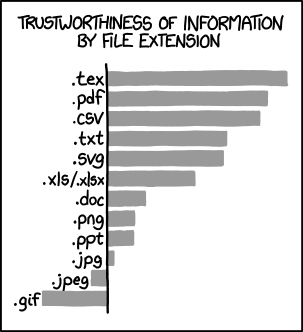
Trustworthiness of information by file extension...
Sources:
http://xkcd.com/1301/
willslabblog.blogspot.co.uk
12 December 2013
Planning for 2014? Our 2014 Almanac will help you in your task.
With over 70 significant, notable and interesting dates for 2014 including major religious festivals and the dates for the full moon.
Standard version | Mobile version
14 November 2013
7 Secrets of Successful Training now available as an eBook.
6 November 2013
'Card-sharp' shows the difference between facilitation and manipulation.
1 July 2013
< Newer Posts | Older Posts >